Si l'eau du robinet paraît propre, pourquoi la filtrer ?
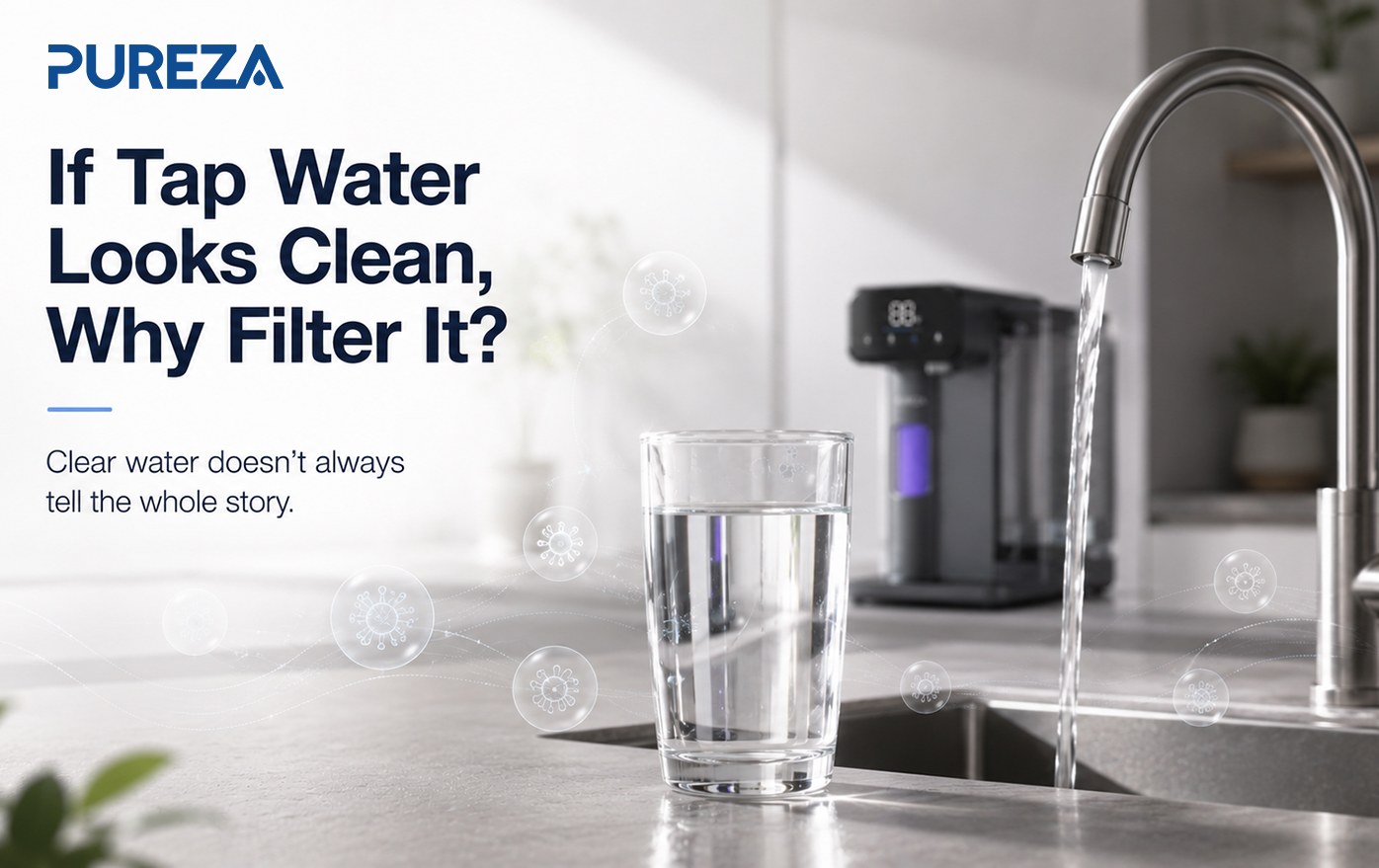
Sep 02, 2026Lorsque vous ouvrez le robinet, l'eau peut paraître parfaitement limpide. Elle ne présente aucune particule visible, aucune couleur anormale et souvent aucun signe évident de problème. Alors, si l'eau du robinet semble propre, pourquoi la filtrer ?
La réponse est simple : La qualité de l'eau ne se résume pas à ce que l'on voit.
Certaines substances susceptibles d'affecter la qualité de l'eau potable sont invisibles à l'œil nu. Selon le réseau d'approvisionnement en eau local, le système de plomberie et l'environnement domestique, l'eau du robinet peut contenir du chlore résiduel, des particules, des métaux, des composés organiques volatils (COV), des PFAS ou d'autres substances non identifiables par simple observation.
Cela ne signifie pas pour autant que l'eau du robinet est forcément impropre à la consommation. Dans de nombreuses régions, l'eau du réseau est traitée et contrôlée avant d'arriver chez vous. Toutefois, la filtration de l'eau peut constituer un traitement supplémentaire pour l'eau potable quotidienne, tout en améliorant son goût et son aspect pratique.
L'eau claire ne signifie pas toujours l'eau pure.
L'une des idées fausses les plus répandues concernant l'eau du robinet est que l'eau claire est forcément de l'eau propre.
En réalité, l'apparence ne révèle que la présence d'impuretés visibles. De nombreux contaminants de l'eau sont présents à des concentrations imperceptibles à l'œil nu, à l'odorat et au goût.
Par exemple, le chlore résiduel est couramment utilisé dans le traitement de l'eau potable pour lutter contre les micro-organismes. Bien que le chlore joue un rôle important dans la désinfection de l'eau, certaines personnes peuvent percevoir son goût ou son odeur dans l'eau potable.
D'autres substances, comme le plomb, les PFAS, certains COV et les particules microscopiques, ne sont pas non plus identifiables simplement en regardant un verre d'eau.
C’est pourquoi l’eau du robinet d’apparence propre et l’eau filtrée ne sont pas nécessairement la même chose.
D’où peuvent provenir les substances indésirables ?
La qualité de l'eau ne dépend pas uniquement du processus de traitement dans une station d'épuration municipale. Après avoir quitté cette station, l'eau traitée circule dans les réseaux de distribution, les canalisations des bâtiments, les tuyaux, les robinets et les conduites d'eau domestiques avant d'arriver dans votre verre.
On peut considérer le parcours global comme suit :
Traitement des eaux municipales → Réseau de distribution → Plomberie du bâtiment → Robinet → Verre
L'état et l'âge des canalisations peuvent varier d'un bâtiment à l'autre et d'un endroit à l'autre. C'est l'une des raisons pour lesquelles on peut constater des différences de goût ou de qualité de l'eau, même lorsqu'on est alimenté par le même réseau municipal.
A distributeur d'eau domestique peut donc servir d'étape de traitement supplémentaire au point d'utilisation, permettant de cibler des substances spécifiques en fonction de la technologie de filtration et de ses performances testées.
Certains problèmes de qualité de l'eau concernent le goût, et non l'apparence.
Avez-vous déjà remarqué que l'eau du robinet a un goût différent de l'eau en bouteille ou filtrée ?
La différence n'est peut-être pas d'ordre esthétique. L'eau peut rester parfaitement transparente tout en présentant un goût, une odeur ou d'autres caractéristiques gustatives chlorées perceptibles.
Pour de nombreux ménages, c'est l'une des principales raisons d'utiliser un filtre à eau de comptoir.
Réduire la quantité de substances responsables du goût et de l'odeur désagréables peut rendre l'eau plus agréable à boire. Et lorsque l'eau a meilleur goût, il est plus facile de la choisir tout au long de la journée plutôt que de consommer des boissons en bouteille.
C'est là que distributeur d'eau froide de comptoir peut offrir plus qu'une simple filtration. Au lieu de filtrer l'eau puis de la transférer dans un récipient séparé pour la refroidir, un système de filtration de comptoir peut combiner filtration et distribution d'eau fraîche dans un seul appareil compact.
Que peut réellement faire un distributeur d'eau ?
Les filtres à eau ne sont pas tous conçus pour éliminer les mêmes substances. Leur performance dépend du média filtrant, de la technologie de la membrane, de la conception du système et des conditions de test.
Selon la technologie de filtration, un filtre à eau peut être conçu pour réduire :
· Chlore, goûts et odeurs désagréables
· Particules et matières en suspension
· Certains métaux lourds comme le plomb
· Composés PFAS sélectionnés
· Certains COV et autres composés organiques
· Microorganismes spécifiques
Il est important de rappeler qu'aucun filtre ne doit être considéré comme capable d'éliminer automatiquement tous les contaminants.
Lors du choix d'un système de filtration d'eauNe vous laissez pas influencer par des affirmations générales telles que « purifie l'eau ». Vérifiez la technologie de filtration réelle, les données de performance et les certifications ou résultats de tests pertinents pour comprendre ce que le système est conçu pour réduire.
La filtration ne sert pas uniquement à traiter l'eau sale.
Donc, si l'eau du robinet paraît déjà propre, cela signifie-t-il que la filtration est inutile ?
Pas nécessairement.
La filtration ne sert pas uniquement à rendre l'eau visiblement sale limpide. Dans de nombreux foyers, elle constitue une étape de traitement supplémentaire pour l'eau potable qui paraît déjà propre.
Voyez les choses ainsi :
La propreté visible ne représente qu'un aspect de la qualité de l'eau.
Un verre d'eau du robinet peut paraître parfaitement limpide tout en contenant des substances qu'un filtre bien conçu est destiné à éliminer. La filtration peut également améliorer le goût et l'odeur, rendant ainsi l'eau du robinet plus agréable à boire au quotidien.
C'est particulièrement utile pour les personnes qui souhaitent améliorer facilement la qualité de leur eau potable sans avoir à effectuer de modifications importantes de leur plomberie domestique.
Pourquoi choisir un distributeur d'eau froide de comptoir ?
Les systèmes de filtration traditionnels sous évier peuvent assurer une filtration efficace au point d'utilisation, mais ils peuvent nécessiter une installation, des modifications de la plomberie et un espace dédié sous l'évier.
Pour les locataires, les résidents d'appartements, les petites cuisines, les bureaux ou les ménages qui préfèrent un configuration plus simple, un distributeur d'eau froide de comptoir peut constituer une alternative pratique.
A purificateur d'eau de comptoir peut combiner plusieurs fonctions quotidiennes :
Filtrer → Distribuer → Refroidir
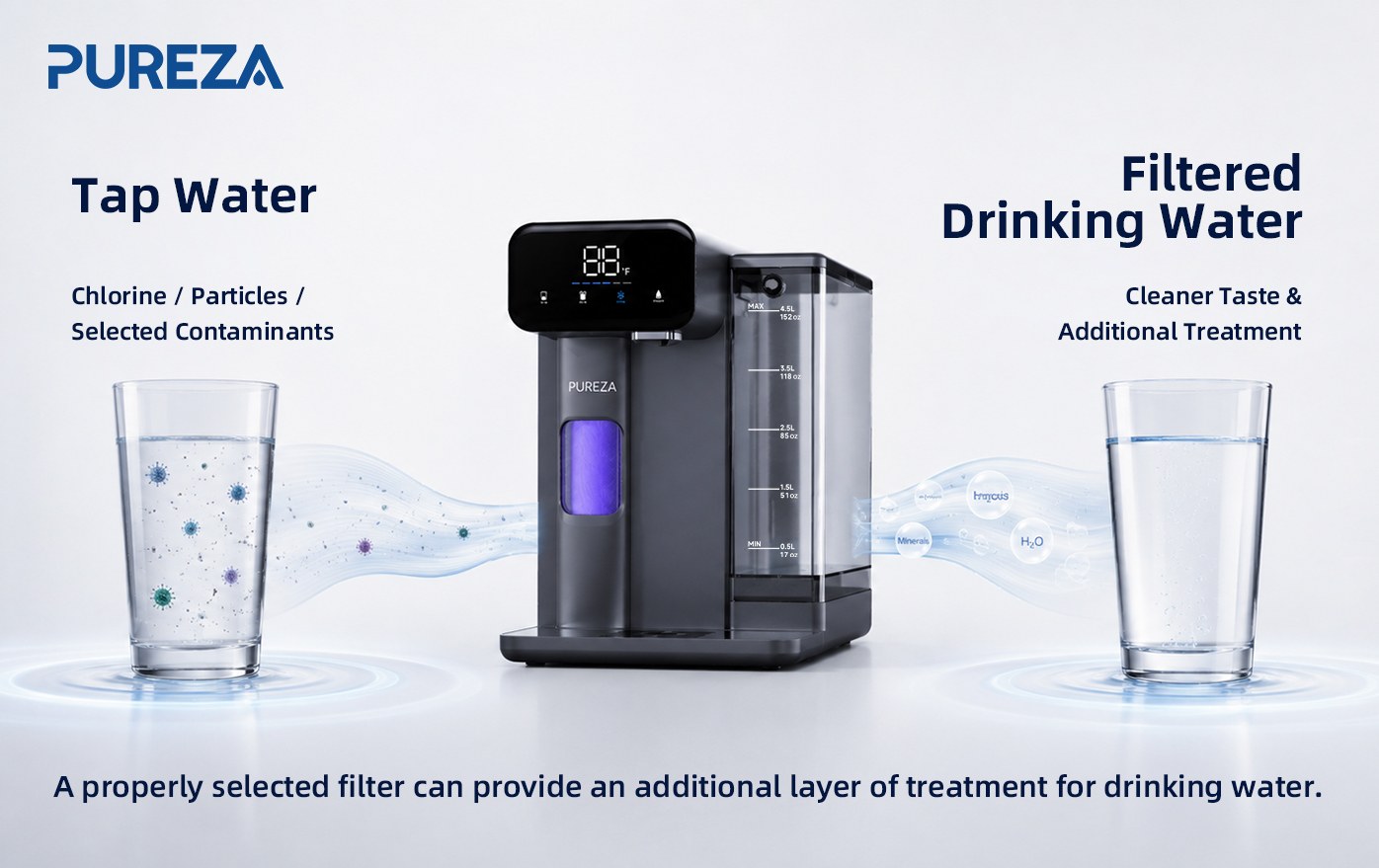
Le Distributeur d'eau froide de comptoir PU-T02 Conçue selon ce principe, cette fontaine à eau filtrée et fraîche se présente sous la forme d'un système compact à poser sur le comptoir, sans installation complexe.
Son système de filtration utilise une membrane chargée positivement conçue pour réduire diverses substances, notamment le chlore, les PFAS, le BPA, le plomb, les résidus pharmaceutiques et les particules. Ce système offre une précision de filtration jusqu'à 0,5 micron et une efficacité de réduction des micro-organismes dans des conditions de test spécifiques.
Ce système élimine également le besoin de rejeter les eaux usées en fonctionnement normal, ce qui le distingue de nombreux systèmes d'osmose inverse classiques.
Bien plus qu'une simple filtration : de l'eau potable fraîche et pratique
La filtration ne représente qu'une partie de l'expérience quotidienne de consommation d'alcool.
Nombreux sont ceux qui souhaitent une eau plus pure, au meilleur goût et bien fraîche. Un filtre à eau, un réfrigérateur et une carafe peuvent répondre à ces besoins, mais ils sont encombrants et nécessitent une utilisation plus intensive.
Le PU-T02 Ce distributeur d'eau froide de comptoir combine filtration et refroidissement.
Il a un Réservoir d'eau d'alimentation de 4,5 litres et fournit un débit de distribution d'environ 1,0 L/minLe système de refroidissement peut abaisser la température de l'eau filtrée à environ 7°C (44°F) dans des conditions de fonctionnement appropriées.
Cela la rend idéale pour une consommation quotidienne, notamment lorsque l'on souhaite de l'eau fraîche sans installer de système de filtration sous l'évier.
Ce système est également conçu pour une utilisation simple sur un plan de travail, ce qui en fait une option pratique pour les cuisines modernes, les appartements, les bureaux et autres espaces où la flexibilité d'installation est importante.
Avez-vous besoin de filtrer l'eau du robinet ?
Il n'existe pas de solution unique pour tous les foyers. Votre réseau d'eau potable, votre plomberie, vos préférences personnelles et les contaminants qui vous préoccupent sont autant d'éléments à prendre en compte.
Vous pourriez envisager d'utiliser un filtre à eau domestique si :
Vous remarquez un goût ou une odeur de chlore dans votre eau du robinet.
Vous habitez dans un immeuble dont la plomberie est ancienne.
Vous souhaitez une réduction supplémentaire de certains contaminants.
Vous préférez le goût de l'eau filtrée.
Vous souhaitez avoir de l'eau potable fraîche à portée de main à la maison.
Vous ne souhaitez pas installer un système de filtration permanent sous l'évier.
Avant de choisir un filtre, il est également conseillé de consulter les informations locales sur la qualité de l'eau et de déterminer quels contaminants sont présents dans votre région.
Alors, si l'eau du robinet paraît propre, pourquoi la filtrer ?
Car ce que vous voyez ne représente qu'une partie de la qualité de l'eau.
L'eau du robinet, même limpide, peut contenir des substances invisibles à l'œil nu. Par ailleurs, le goût et l'odeur peuvent influencer le plaisir gustatif. Un système de filtration d'eau adapté offre un traitement supplémentaire et contribue à réduire certains contaminants, selon ses performances.
Pour les ménages à la recherche d'un Combinaison pratique de filtration et d'eau potable fraîche, un distributeur d'eau froide de comptoir tel que le PU-T02 offre une solution pratique au point d'utilisation.
Au lieu de se demander si l'eau du robinet paraît propre, une meilleure question serait :
Que contient réellement l'eau, et quel traitement supplémentaire souhaitez-vous pour votre eau potable quotidienne ?
Ce changement de perspective est la véritable raison pour laquelle la filtration de l'eau reste précieuse, même lorsque l'eau qui sort de votre robinet semble parfaitement claire.